
Professional Character in Public Service: Why It Is a Trust Issue, Not a Performance Issue

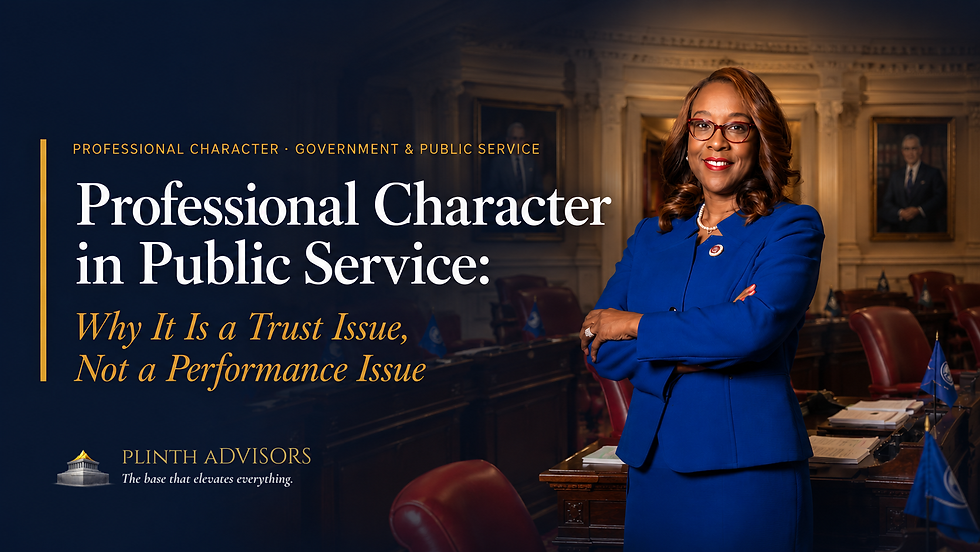
When you work in public service, your professional behavior is not just a reflection of you. It is a reflection of the institution you represent and the community that placed its trust in that institution. That is a different kind of accountability from that in the private sector.
In a private organization, a character failure affects the company and its stakeholders. In a public organization, it affects people who had no say in whether they trusted you. It was built into the transaction the moment someone paid a tax bill, applied for a permit, or called a government line expecting to be treated with competence and respect.
That distinction matters.
And most professional development programs designed for public sector employees do not account for it.
The Standard Is Different Because the Stakes Are Different
Public service has always carried an implicit character contract. The public does not just expect government employees to do their jobs correctly. They expect them to do their jobs with integrity, even when no one is watching. Especially when no one is watching.
This is not a statement about government employees being held to an unfair standard. It is a statement about the nature of the work. When a city council member or a case worker or a permit officer behaves in ways that are inconsistent, dismissive, or self-serving, the ripple effect is not contained to a performance review. It erodes something that is much harder to rebuild: public confidence in the institution itself.
Professional character in public service is not a soft skill. It is a structural component of institutional trust.
Public-sector organizations spend significant resources on technical training, compliance, and systems. They spend considerably less time asking the harder question: are the people inside this institution behaving in ways that build or erode the trust the public has placed in us?
What This Looks Like on the Ground
Consider three scenarios that play out regularly in government settings.
The first is the supervisor who manages by seniority rather than accountability. They are technically competent and have been in the role long enough to know the system. But they consistently defer to whoever has the most tenure in the room, avoid difficult performance conversations, and allow culture to drift toward compliance rather than character. No policy is violated. But something important is being lost.
The second is the frontline employee who has learned that internal politics matter more than doing the right thing for the person standing at the counter. Their follow-through is inconsistent. Their communication is technically adequate but often leaves people confused or feeling dismissed. They are not failing any audit. But they are quietly failing the public trust, one interaction at a time.
The third is the emerging leader who was promoted based on their technical record and their years of service. They wanted the promotion. They earned it based on the metrics in place. But no one assessed whether they were ready for the professional character demands of a leadership role in a public institution, where decisions have community consequences and credibility is built slowly and lost quickly.
None of these situations requires a policy change. All three require a professional character conversation.
Professional Character and Public Accountability Are Not Separate Conversations
The most effective public sector leaders understand something that does not always make it into leadership development curricula: accountability is not a mechanism you apply to other people. It is a posture you first inhabit yourself.
When leaders in government organizations demonstrate ownership over their decisions, follow through on their commitments without being reminded, and communicate in ways that treat constituents and colleagues as people deserving of clarity, something shifts in the culture around them. Not because they mandated it. Because they modeled it.
This is not idealism. It is organizational dynamics. People take their behavioral cues from what they see rewarded, tolerated, and modeled at the top. In a public sector organization, the top sets the tone not just for the team but also for the community's experience with the institution. To the public, the people are the institution.
The public does not separate how an institution performs from how its people behave. Neither should you.
What a Diagnostic Sprint Reveals in a Public Sector Context
Plinth Advisors works with government agencies and public sector organizations on workforce character and leadership readiness. The starting point is always the same: a Diagnostic Sprint that gives the organization an honest picture of where its people are performing against the behavioral foundations that professional character requires.
In public sector engagements, the Diagnostic Sprint often reveals patterns that leaders already sensed but had not measured. Follow-through gaps. Communication inconsistency. Leaders who are effective in technical roles but underprepared for the relational and ethical demands of managing people in a high-accountability environment.
The goal is not to identify who is failing. The goal is to identify where the organization can build, so that the people inside it are equipped to deliver on the trust the public has extended to the institution.
That is a worthy investment. And in public service, it is also a responsibility.
Ready to talk about what professional character looks like in your agency or public sector organization?
Plinth Advisors works with government agencies and public sector organizations on workforce character and leadership readiness. Learn more and schedule a discovery conversation at plinthadvisors.com.
Plinth Advisors | The base that elevates everything.


Comments